

Location is Everything IELTS Reading Samples
Prepared by Svarna Training Institute Academic Team
Below is a complete IELTS Reading Sample Test, ready for practice. It has been crafted specifically for students of Svarna Institute by the Svarna Academic Team. This test is equivalent to an IELTS Band 9 level and is aligned with the popular reading material, 'Location is Everything,' woven into the legendary story of Robin Hood of Locksley and Sherwood Forest.
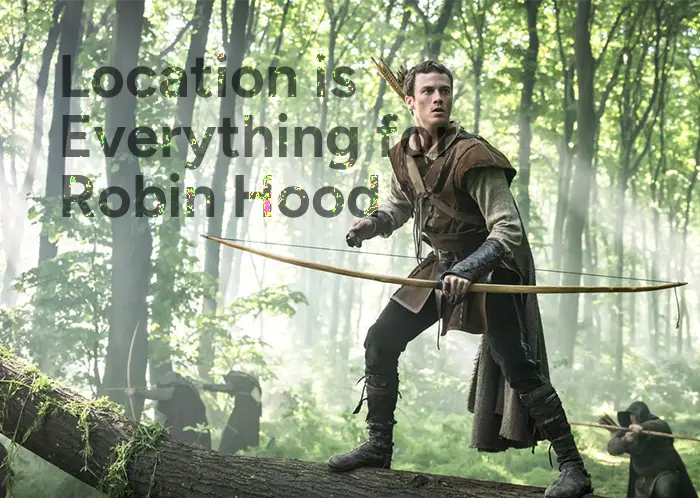
Robin Hood of Locksley & Sherwood
History often celebrates heroes for their courage, skill, or moral strength. Yet, behind many legendary figures lies another silent force that shaped their destiny, location.
Few stories illustrate this more vividly than the legend of Robin Hood of Locksley, whose rise as a folk hero was inseparably tied to the geography of Sherwood Forest, the surrounding villages, and even the secret paths that led him to his beloved Maid Marian.
Robin Hood’s transformation from a dispossessed nobleman into an outlaw champion of the poor did not occur in isolation. It occurred in a landscape that protected him, concealed him, and empowered him. Sherwood Forest, stretching across Nottinghamshire, was not merely a background setting but an active participant in his legend.
The forest’s vastness made it difficult for the Sheriff of Nottingham’s forces to navigate. Dense oak trees, uneven terrain, and narrow tracks provided Robin and his band of Merry Men with a decisive advantage. These natural features allowed them to vanish quickly after ambushes, reinforcing the idea that knowing where to fight mattered as much as knowing how to fight.
Equally important were the hidden places within Sherwood. Legends speak of concealed camps, underground shelters, and natural clearings invisible to outsiders. These locations enabled Robin’s group to plan attacks, store supplies, and remain undetected for extended periods. Without such refuges, their survival against royal authority would have been impossible.
Strategic positioning also allowed Robin Hood to control trade routes passing through the forest. Merchants, tax collectors, and noble travellers were forced to use specific paths, making them predictable targets. Robin’s success in redistributing wealth depended not on random acts of rebellion, but on a precise understanding of movement and location.
Beyond warfare and strategy, location shaped Robin Hood’s personal life, particularly his relationship with Maid Marian. Marian, often depicted as living within or near aristocratic estates or convents under royal protection, was physically separated from Robin by political boundaries. However, hidden woodland paths, river crossings, and forest corridors allowed Robin to reach her secretly.
These secret routes were more than romantic devices; they symbolised resistance. Each journey Robin made to see Marian was a quiet defiance of authority, made possible only because of his deep knowledge of the land. Love, like rebellion, relied on geography.
The contrast between urban and rural spaces further amplified Robin’s legend. Nottingham represented control, law, and corruption, while Sherwood symbolised freedom and justice. By choosing the forest as his base, Robin transformed location into a political statement. His very presence in Sherwood challenged the Sheriff’s authority and undermined the reach of the Crown.
Over time, Sherwood Forest itself became legendary. Ballads and stories elevated it from a real location into a symbol of resistance, safety, and hope. Visitors came to associate the forest with fairness and bravery, showing how a place can inherit meaning from the actions performed within it.
Ultimately, Robin Hood’s legend teaches a powerful lesson, success is rarely determined by skill alone. It is shaped by environment, access, concealment, and control of space. Without Sherwood Forest, without hidden routes, and without strategic locations, Robin Hood may never have become more than a forgotten rebel.
In the story of Robin Hood, location was not simply important, it was everything.
Questions 1–10
Answer the questions below using no more than (3) THREE WORDS from the passage.
1. Which forest served as Robin Hood’s main base of operations?
2. What natural feature made it hard for soldiers to pursue Robin?
3. What term is used to describe Robin’s close companions?
4. What did Robin control by understanding forest pathways?
5. Which authority figure tried to capture Robin Hood?
6. Where did Robin hide supplies and plan attacks?
7. Who was Robin Hood’s romantic interest?
8. What locations allowed Robin to reach Marian secretly?
9. What city symbolised corruption and authority?
10. What broader lesson does the passage highlight about success?
Questions 11–20
Choose the correct letter, A, B, or C. Circle the right answer.
Why was Sherwood Forest ideal for Robin Hood?
A. It was close to the king’s castle
B. It offered concealment and escape routes
C. It was owned by the poor
Robin’s success depended mostly on?
A. His physical strength
B. Random attacks
C. Knowledge of location
The hidden camps were mainly used for?
A. Training soldiers
B. Planning and survival
C. Farming
Trade routes were important because they?
A. Were unknown to travellers
B. Made targets predictable
C. Led directly to castles
Maid Marian was difficult to reach because?
A. She disliked Robin
B. She lived under protection
C. She lived abroad
The secret paths symbolised?
A. Nature’s beauty
B. Romantic fantasy
C. Resistance to authority
Nottingham represents?
A. Freedom
B. Justice
C. Control and corruption
Sherwood Forest became legendary because?
A. It was unexplored
B. Of the stories told about it
C. Of the king’s support
The passage suggests Robin would fail without?
A. Weapons
B. Friends
C. Strategic locations
The main theme of the passage is that?
A. Love is powerful
B. Forests create heroes
C. Location determines success