

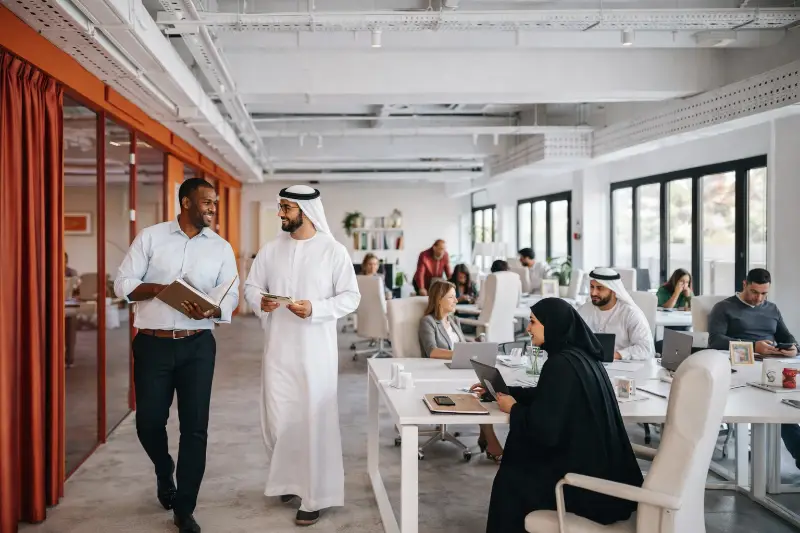
There is a quiet shift happening inside meeting rooms across Dubai. It’s not announced with press releases or policy memos, but you can feel it in the pauses between conversations, in the way leaders ask different questions now, and in how HR managers are no longer sitting at the edge of the table. They’re at the center.
Dubai has always been a city that moves faster than its own reflection. Towers rise before doubts settle. Industries evolve before job titles fully form. And in this environment, Human Resources has stopped being a support function. It has become the system that decides whether growth will be sustainable or fragile.
When we talk about the latest HR trends, we often reduce them to buzzwords, AI, hybrid work, well being, skills. But in Dubai, trends don’t arrive as ideas. They arrive as requirements. They turn quickly into HR priorities that demand action, clarity, and courage.
01. Emiratization 2.0 and Local Talent
For years, Emiratization was spoken about in targets and percentages. How many nationals were hired. Which departments complied. Whether quotas were met. But something has changed. In forward thinking organizations, Emiratization is no longer a hiring KPI it’s a development story.
The latest HR trends in Dubai show a clear move toward Emiratization 2.0, where the question is not how many Emiratis were hired, but how many stayed, grew, and were trusted with leadership. HR managers are now designing mentoring pipelines, fast track leadership programs, and role based capability journeys that actually mean something beyond compliance.
This shift requires HR to work closely with business heads, not just recruiters. It requires patience, investment, and a willingness to measure success through retention and progression not just onboarding. Among all HR priorities in Dubai, this one carries both responsibility and legacy.
Fun Facts
✦ MOHRE now actively tracks Emirati retention, not just hiring. If a UAE national resigns, companies have two months to replace them before penalties apply.
✦ Organizations that exceed targets by three times or more are upgraded to Tier 1 status, enjoying up to 80% discounts on work permit fees.
✦ Remote roles for Emiratis are also rising, especially for nationals living in the Northern Emirates, allowing them to work for Dubai firms without daily travel.
02. Compliance with Evolving UAE Labour Law
Dubai’s labour framework has evolved rapidly, and with it, expectations from employers. Fixed term contracts, flexible work models, extended claim periods, dispute mechanisms these are no longer legal footnotes. They shape everyday employee experience.
One of the most overlooked latest HR trends is the movement of compliance away from HR desks and into line management behavior. The smartest HR teams are no longer just updating policies, they are training managers to apply them humanely and correctly.
Terminations, remote work clauses, performance management, anti harassment safeguards these decisions are happening at manager level, and HR is now the educator, not just the enforcer.
In Dubai’s multicultural workforce, clarity is kindness. Well communicated policies, multilingual handbooks, and manager training have become essential HR priorities, not administrative chores.
Fun Facts
✦ Labour disputes below AED 50,000 are now settled by the Court of First Instance with no right of appeal, protecting low wage employees from prolonged legal battles.
✦ Employees now have two years to file claims after leaving a job, instead of one.
✦ During disputes, if wages stop, MOHRE can force employers to continue paying for up to two months while the case is reviewed.
03. Hybrid Work, Structure Is the New Flexibility
Flexibility without structure doesn’t empower it confuses. Dubai learned this quickly after the global experiment with remote work. Employees want flexibility, but they also want fairness, clarity, and trust.
One of the strongest latest HR trends shaping Dubai organizations is the formalization of hybrid work. Who can work remotely? How many days? How is performance measured? How is data protected? These questions now demand documented answers.
HR teams are stepping into a new role here, architects of work design. They are building models that balance productivity with autonomy, while training managers to lead teams they don’t physically see every day. Output based KPIs, inclusive meeting practices, and regular check ins have replaced physical presence as measures of commitment.
Fun Facts
✦ Although 27% of UAE firms ordered a full return to office in 2026, actual attendance rose by only 1–3%. Most employees ignored mandates, and HR quietly accepted it.
✦ RTA studies show that if 20% worked remotely, traffic on Sheikh Zayed Road would drop by 10% instantly. Yet, 87% of managers admit promotions still favor employees they see in person.
Hybrid work is no longer an employee perk. It is a strategic HR priority tied directly to attraction, retention, and employer credibility.
04. AI in HR, Power With Responsibility
Automation has quietly entered almost every HR function in Dubai recruitment screening, payroll, attendance, analytics. But the latest HR trends are not about whether AI should be used. They’re about how responsibly it is governed.
Leading HR teams are implementing AI assisted systems while simultaneously developing ethical frameworks. Bias checks, transparency, and human review are no longer optional add ons. They are essential safeguards.
What makes this an HR priority rather than an IT one is interpretation. Data without context is dangerous. HR professionals are now expected to understand analytics deeply enough to challenge them, explain them, and translate them into humane decisions. Technology has not reduced HR’s role it has made it more intellectually demanding.
Fun Facts
✦ AI has reduced the average hiring time in the UAE from 45 days to 29 days. By late 2026, HR AI agents handle 20% of routine HR tasks, such as leave approvals and payroll queries. Employees can now generate salary certificates, NOCs, and bank letters anytime, even at 3 AM Sundays, without waiting for HR.
05. Skills Based Hiring and Upskilling
Walk into any Dubai organization today and ask what roles they need in three years. The honest answer is, they don’t know. But ask what skills they will need, and clarity emerges.
One of the most defining latest HR trends is the move toward skills based workforce planning. HR teams are mapping capabilities instead of credentials, identifying gaps, and building continuous learning ecosystems to close them.
Fun Facts
✦ In 2026, 40% of Dubai job ads in admin, tech, finance, sales, and marketing no longer require a degree, focusing instead on skills and certifications. Some companies now offer learning bonuses, paying employees cash for completing certified courses. Soft skills like empathy, emotional intelligence, and conflict resolution are now the #1 most searched, most demanded skills in the UAE job market.
Micro learning, internal academies, certifications aligned to UAE market demand these are no longer learning initiatives. They are survival strategies. Among modern HR priorities, enabling people to evolve faster than roles change has become non negotiable.
06. Employee Well Being and Mental Health
There was a time when employee well being was reduced to yoga sessions and awareness emails. That time has passed. Dubai’s high pressure work environment has made mental, physical, and financial well being a serious business concern.
The latest HR trends show organizations implementing structured well being frameworks supported by manager training, early intervention tools, and real data. Pulse surveys, EAP insights, and stay interviews are helping HR identify stress before it becomes attrition.
Well being has become one of the most human HR priorities and also one of the most strategic. Healthy employees don’t just perform better; they stay longer, contribute more, and trust leadership deeper.
Fun Facts
✦ UAE studies show an 800% return on investment for mental health programs. for every $1 spent on corporate mental health initiatives, companies see an $8 return in productivity and reduced absenteeism.
✦ A staggering 69% of UAE employees say their direct manager has more impact on their mental health than their therapist or doctor.
✦ In 2026, “Wellness Pantries” are replacing soda and chips with cold pressed juices and organic fruit platters as a standard office perk. Companies in the UAE are hiring “Head of People & Happiness” roles to specifically manage office culture and stress levels.
07. Diversity, Inclusion and Fair Treatment
Dubai’s diversity is real but inclusion doesn’t happen automatically. It must be designed, measured, and protected.
HR teams are strengthening anti harassment policies, refining reporting mechanisms, and tracking promotion, pay, and attrition data to identify silent inequities. Gender balance, nationality mix, accessibility these are no longer brand statements. They are operational metrics.
Among the latest HR trends, inclusion has shifted from intention to accountability. HR priorities now include ensuring fairness is not assumed but proven.
Fun Facts
✦ The “Blind CV” Trending with 15% of Dubai’s top firms now use “Blind Recruitment,” where the candidate’s name and photo are hidden until the final interview stage to ensure fairness. A popular trend in JAFZA and DIFC firms is “Culture Share” Days, where employees are given a budget to share their national food and traditions with the team.
08. Data Driven People Decisions
Data alone doesn’t earn HR a seat at the table. Insight does.
Modern HR teams in Dubai are building focused dashboards that track what matters: hiring velocity, Emiratization progress, engagement, learning ROI, absenteeism, pay equity. But more importantly, they are using this data in leadership discussions not as reports, but as decision inputs.
One of the most powerful latest HR trends is this repositioning of HR as a strategic advisor, shaping workforce planning, productivity, and cost discipline. Data has become HR’s language of credibility.
Fun Facts
✦ Dubai is one of the few cities in the world that built a government level “HR Register” to centralize employee data so leaders can simulate the impact of HR policies like promotions or training before they roll them out in real life.
09. Employer Brand and Talent Attraction
In Dubai’s competitive talent market, employer branding is no longer about glossy career pages. It’s about experience. Speed of hiring. Transparency of communication. Authenticity of leadership.
HR teams are aligning candidate journeys with digital expectations, leveraging employee advocacy, and clearly articulating what makes their workplace worth choosing. Hybrid work, growth pathways, Emirati development, ESG values these are now part of the employer promise.
Among all HR priorities, this one directly shapes who knocks on your door and who doesn’t.
Fun Facts
✦ Gen Z candidates in the UAE discover jobs through TikTok “Day in the Life” videos. Companies with weak social media lose up to 40% of young applicants. For 62% of candidates, Glassdoor and Indeed ratings matter more than salary. Top talent now also asks about ESG and Net Zero goals, and companies without sustainability plans are being rejected.
10. Workforce Planning and Cost Discipline
Perhaps the most sobering of all HR priorities is workforce planning. Dubai organizations are learning to plan for growth while preparing for volatility. Automation, AI adoption, regulatory shifts, and economic cycles demand agility.
HR is now balancing headcount optimization, flexible staffing, and targeted retention instead of blanket hiring or freezes. This long term thinking often spanning two to three years marks the maturity of HR as a business function.
Fun Facts
✦ UAE SMEs lose up to AED 120,000 annually from basic HR slip ups like payroll errors and poor attendance tracking, but switching to automated systems can cut that waste by 15% enough to fund a new hire or that team outing you’ve been promising.
Where HR Stands Now
Dubai’s HR landscape is no longer catching up. It is defining its own model, one shaped by regulation, diversity, ambition, and speed. The latest HR trends are not abstract ideas floating in conferences. They are real pressures faced daily by HR managers making decisions that affect livelihoods, culture, and growth.
The difference between average HR teams and exceptional ones is not knowledge. It is intentionality. Clear HR priorities, translated into consistent action, supported by leadership, and grounded in humanity.
This is HR’s moment in Dubai not to follow trends, but to lead responsibly.
Frequently Asked Questions (FAQs)
Q1. What are the biggest HR trends shaping Dubai right now?
Dubai’s workplace is evolving fast, and the latest HR trends reflect that pace. Emiratization 2.0, AI powered HR systems, skills based hiring, structured hybrid work, and a sharper focus on employee experience are leading the shift. Together, these trends are redefining HR priorities, pushing HR teams to move beyond administration and play a more strategic role in driving growth, compliance, and workforce readiness.
Q2. How is Emiratization reshaping HR priorities in the UAE?
Emiratization is no longer a side initiative, it sits at the core of modern HR priorities. With expanding quotas and stricter enforcement timelines, especially heading into 2026, HR teams must embed Emirati hiring, development, and retention directly into workforce planning and performance metrics. Among the latest HR trends, the real shift is treating Emiratization as a long term talent strategy, not just a compliance requirement.
Q3. What role does AI play in Dubai’s HR landscape today?
AI has become one of the most influential latest HR trends in Dubai, transforming recruitment, workforce planning, and people analytics. HR teams are using AI to screen candidates, forecast attrition, and automate routine tasks. The real HR priority is balance using AI to improve efficiency while maintaining transparency, managing bias, and protecting employee data.
Q4. Is hybrid work still relevant, or are companies returning fully to offices?
Hybrid work is no longer an experiment it’s a permanent feature of Dubai’s labour market. Many organisations now operate with clear hybrid frameworks that define office days, flexible hours, and performance expectations. As part of the latest HR trends, flexibility has become a major attraction and retention lever, making it a non-negotiable HR priority for competitive employers.
Q5. Why is skills based hiring gaining so much attention?
Because job roles are changing faster than job titles can keep up. One of the most practical latest HR trends is the move away from degree driven hiring toward skills mapping and capability development. For HR leaders, this shift changes HR priorities from filling vacancies quickly to building adaptable talent pipelines that can evolve with technology and market demand.
Q6. How are employee experience and well being being redefined?
Employee experience in Dubai is becoming more personal and data driven. Organisations are tailoring learning paths, benefits, and communication channels to individual needs, while integrating mental, physical, and financial well being into one ecosystem. Among today’s latest HR trends, this holistic approach has emerged as a core HR priority for retention, engagement, and long term performance.
Q7. What compliance and labour-law issues should HR teams watch closely?
Dubai HR teams are navigating frequent updates around contract structures, dispute resolution, flexible work policies, and anti harassment regulations. Compliance is now one of the most critical HR priorities, especially in multinational workforces. One of the defining latest HR trends is the shift toward proactive compliance training managers early rather than fixing issues after they arise.
Q8. How important are diversity, inclusion, and ESG for HR in Dubai today?
Diversity, inclusion, and ESG have moved from “nice to have” to strategic necessity. Employers are focusing on fair treatment, gender balance, and inclusive leadership while aligning talent strategies with sustainability goals. Among the latest HR trends, ESG driven workforce planning is rising fast, making responsible hiring and development a growing HR priority across sectors.
Q9. What people analytics capabilities are organisations investing in?
Dubai organisations are building analytics dashboards that track engagement, turnover, skills gaps, and Emiratization progress. But the real value lies in prediction, not reporting. One of the most impactful latest HR trends is using data to anticipate risks before they become problems turning analytics into a strategic HR priority rather than a monthly report.
Q10. As an HR manager in Dubai, what should I focus on first?
Start where impact is immediate. Align your workforce strategy with Emiratization and labour law changes, modernise HR systems with AI and automation, and invest in skills development and employee experience. These form the foundation of today’s HR priorities. Once stable, you can scale into advanced analytics, ESG initiatives, and employer branding following the roadmap set by the latest HR trends in the UAE.
HRM Related Posts
- Beginners Guide to Payroll and Tax Services in UAE, 11 Things you need to know
- Copy this Bullet Proof HR Recruitment Process in UAE for Your Company in 2026
- HR Policies in UAE (2026 Guide) Legal HRM Compliance Explained
- Learn Everything About HR Document Management System (DMS) in 2026
- The Only Onboarding and Offboarding Process UAE Companies Need in 2026 (Playbook + Checklist)
- These 10 Latest HR Trends Are Redefining Traditional HR Priorities in Dubai 2026
- UAE Labour Law 2026 (Guide) 22 Rules Every Employee and HR Must Know