



How Onboarding and Offboarding Process Decide the Fate of Your Company
It usually doesn’t fail loudly. It fails quietly.
A high potential hire joins your organisation in Dubai with excitement, ambition, and trust. The offer letter was promising. The interviews were warm. Expectations are high.
But Day One arrives and no one is ready. The laptop is missing. Access is delayed. No one knows who owns the induction. The manager is busy.
HR is firefighting visas. The employee smiles politely and mentally checks out.
Six months later, during probation, performance feels “below expectations” The exit is rushed. Knowledge walks out. Access isn’t revoked properly. The settlement is delayed. A Glassdoor review quietly appears.
This is not an HR failure. This is a process failure.
In the UAE, where labour laws, visas, Emiratization targets, cultural diversity, and compliance timelines intersect, the onboarding and offboarding process is no longer administrative hygiene. It is a strategic risk control system.
Before we go any further, let’s answer the most basic yet most misunderstood question.
What is onboarding, really?
What is onboarding is not about orientation slides or collecting documents. It is the structured journey that transforms a selected candidate into a confident, compliant, productive insider legally, culturally, and emotionally.
And at the other end of the lifecycle sits its equally powerful counterpart.
Employee offboarding is not about collecting laptops and closing files. It is the disciplined, respectful exit that protects your organisation, preserves your brand, and leaves the door open even when the relationship ends.
This guide is written for UAE HR leaders, people managers, founders, and compliance professionals who want more than templates. It is built to take you from zero to mastery, blending law, culture, automation, and human psychology into a bulletproof system you can actually run.
The UAE Reality You Must Design Around
HR processes do not live in theory. In the UAE, they live inside law, visas, and cultural nuance.
Before designing anything, you must understand the terrain. Legal foundations that shape onboarding and exits.
UAE employment is governed primarily by Federal Decree Law No. 33 of 2021 and its amendments, alongside MOHRE regulations, free zone authorities, and internal company policies.
Your onboarding and offboarding process must account for,
- Offer letters vs labour contracts
- Probation caps (maximum six months)
- Notice periods and early termination rules
- End of Service gratuity calculations
- Visa issuance, transfers, and cancellations
- Experience certificates and final settlements
A perfect onboarding experience that ignores visa timing is not perfect. A warm exit that delays settlement is not respectful, it’s risky.
Mainland vs Free Zone complexity
HR leaders in the UAE often manage employees across,
- Mainland (MOHRE)
- DIFC / ADGM
- JAFZA and other free zones
Each jurisdiction tweaks contracts, dispute resolution, and termination handling. A single universal checklist rarely works. The smartest teams design modular processes that adapt without breaking compliance.
Cultural intelligence is not optional
The UAE workforce is global. Emiratis, long term expats, first time arrivals, blue collar staff, senior executives all enter with different expectations.
Your onboarding tone during Ramadan, your communication style with Emirati hires, your clarity for first time expats navigating Emirates ID and banking these are not “nice touches.” They are trust signals.
Designing an Onboarding Strategy That Actually Works
Strong onboarding is intentional. Weak onboarding is accidental.
High performing UAE organisations stop asking, “What should HR do on Day One?” and start asking, “What should the employee feel, know, and be able to do at each stage?”
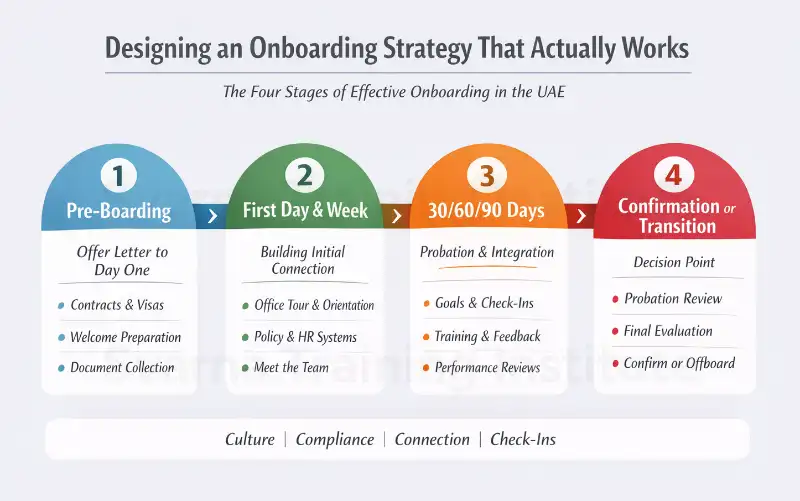
The four stages of onboarding in the UAE
A resilient onboarding and offboarding process begins long before Day One.
- Pre boarding (offer accepted to Day One)
- First day and first week
- 30/60/90 day integration and probation
- Confirmation, growth, or exit decision
Each stage has legal, emotional, and operational outcomes.
Download HR Onboarding Checklist (PDF)
Stage 1 – Pre Boarding where Most UAE Companies Already Fail
Pre boarding is the silent predictor of success.
From the moment a candidate accepts, uncertainty begins. Visas. Medical tests. Document lists. Timelines. Silence creates anxiety and anxiety kills engagement.
This is where your employee onboarding form becomes a strategic asset.
What your pre boarding must cover
In the UAE context, pre boarding typically includes,
- Offer letter issuance (MOHRE or free zone compliant)
- Document collection (passport, visa, photos, certificates)
- Medical fitness coordination
- Work permit and Emirates ID initiation
- Contract preparation and signing
- IT, access, and workspace preparation
A well designed employee onboarding form centralises this chaos into clarity. It reduces back and forth, errors, and delays.
Pre boarding communication should explain,
- What will happen next
- Who to contact
- Expected timelines
- First day logistics
Silence is interpreted as disorganisation.

Stage 2 – The First Day and First Week, Trust Is Built Here
Day One is not about policies. It’s about belonging.
The employee arrives asking three unspoken questions,
- Do I matter here?
- Am I safe and supported?
- Did I make the right decision?
Your job is to answer “yes” without saying it.
What a strong first week includes
- A structured welcome, not a rushed introduction
- Office tour and team introductions
- Clear explanation of policies, working hours, and leave
- HR systems walkthrough
- Data protection and security briefing
- Manager alignment on role expectations
Small things matter. A welcome email from leadership. A named buddy. A prepared workstation.
These are not perks. They are signals of organisational maturity.
Stage 3 – 30/60/90 Days Probation Is Not a Waiting Period
In the UAE, probation is capped. That alone should force discipline. Yet many organisations drift through it, only to panic near the end.
A structured 30/60/90 day plan,
- Aligns expectations
- Surfaces performance gaps early
- Protects legal decision making
- Builds psychological safety
This is where your HR onboarding checklist shifts from administration to performance.
Regular check ins, documented feedback, and role clarity turn probation from a risk into a proving ground for both sides.
For Emirati hires, this stage often links directly to Emiratization KPIs, mentorship, and long-term capability building.
Offboarding – Why Exits Deserve the Same Respect as Entries
Most organisations celebrate beginnings. Very few honour endings.
The truth is, the real character of an organisation is rarely revealed during onboarding. It is revealed during exit. When emotions are mixed, when trust is fragile, when expectations collide with reality that is when systems either hold or collapse.
Employee offboarding is not the opposite of onboarding. It is its mirror.
If onboarding answers the question “Do I belong here?”, offboarding answers something far more powerful, “Was I respected here even at the end?”
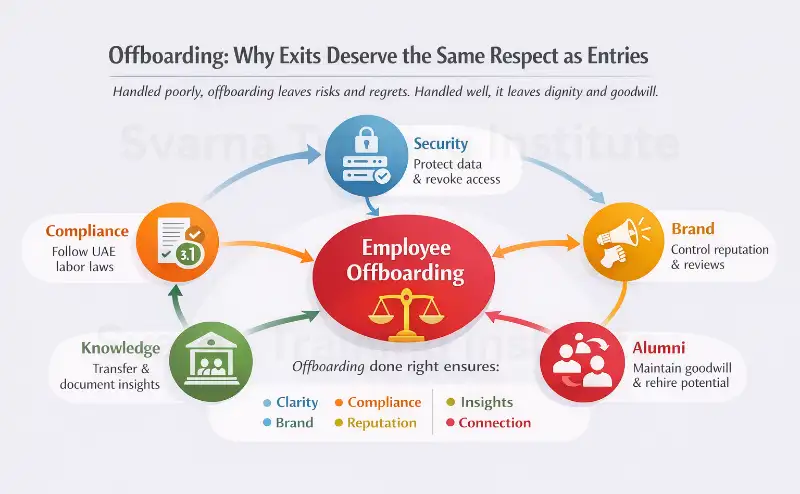
In the UAE, where professional networks are tight, industries overlap, and reputations travel faster than résumés, exits leave long shadows. A poorly handled departure doesn’t just affect the existing employee, it affects the team watching silently, the candidates researching quietly, and the employer brand being evaluated invisibly.
A mature onboarding and offboarding process recognises that exits are not administrative closures. They are emotional transitions, legal events, and reputational moments happening simultaneously.
From a business perspective, offboarding protects,
- Confidential data and system access
- Client relationships and institutional knowledge
- Legal compliance around final settlements and gratuity
- Employer brand on platforms like Glassdoor and LinkedIn
From a human perspective, it protects dignity.
A respectful offboarding process acknowledges contribution, enables proper handover, ensures clarity around dues, and allows people to leave without bitterness even when the separation is difficult. And when done right, it creates something rare, former employees who still speak well of the organisation.
In a region like the UAE, where talent often returns in different roles, different companies, or different stages of life, today’s exit can easily become tomorrow’s re entry.
That is why offboarding deserves the same design thinking, structure, and leadership attention as onboarding sometimes even more.
Triggers That Shape Offboarding in the UAE
Not all exits are the same. Treating them as such is where most UAE organisations go wrong.
Every offboarding journey begins with a trigger and in the UAE, that trigger fundamentally reshapes timelines, tone, compliance steps, and risk exposure.
A resignation from a senior manager who has secured another role in Dubai carries a very different emotional and legal weight than a probation failure, a redundancy, or an end-of-project exit for an expat employee returning home.
Understanding these triggers is essential to designing a resilient offboarding checklist.
Common offboarding triggers in the UAE include,
- Voluntary resignation
- End of limited term contract
- Non confirmation during probation
- Termination for performance or misconduct
- Redundancy or restructuring
- End of project or assignment
- Internal transfer to another UAE entity
Each trigger affects,
- Notice period requirements
- Visa cancellation or transfer timelines
- End of service gratuity eligibility
- Communication strategy with stakeholders
- Emotional handling of the exit
For example, an expat resigning to leave the UAE entirely requires coordination around visa cancellation, bank accounts, final settlement, and sometimes school or housing letters. In contrast, an employee moving to another UAE employer may require visa transfer coordination rather than cancellation changing the entire flow of employee offboarding.
Similarly, probationary exits must be handled with extreme care. UAE labour law allows termination during probation with specific notice rules, but poor documentation or rushed communication can still expose organisations to disputes.
This is where many HR teams fail not because they lack intent, but because they rely on a single static checklist instead of trigger based pathways.
High maturity HR functions design offboarding like a decision tree,
- What triggered the exit?
- What jurisdiction applies (MOHRE vs free zone)?
- What timelines are legally mandatory?
- What emotional temperature must we manage?
When offboarding is shaped by the trigger not habit it becomes predictable, defensible, and humane.

The Step by Step Offboarding Checklist
A reliable offboarding checklist protects people and systems. A disciplined UAE aligned flow typically includes,
- Formal confirmation of exit and last working day
- Communication planning (internal and external)
- Knowledge transfer and handover documentation
- Asset recovery and IT access revocation
- Final settlement, gratuity, and statutory letters
- Exit interview and alumni management
This is not bureaucracy. It is organisational hygiene.
Download HR Offboarding Checklist (PDF)
Automation – How Smart UAE HR Teams Scale Without Chaos
Manual HR processes do not scale. They fracture.
Modern HRMS platforms allow you to,
- Trigger workflows on hire or resignation
- Automate approvals and reminders
- Track visa and document timelines
- Ensure checklist completion
In the UAE, automation shines when managing,
- Visa expiry alerts
- MOHRE contract renewals
- Asset tracking across locations
- Compliance reporting
Automation doesn’t remove human touch. It protects it by removing noise.
Measuring What Actually Matters
If onboarding and offboarding feel chaotic, it is usually because they are invisible.
What is not measured is not managed and in HR, what is not managed slowly becomes culture.
Many organisations proudly maintain an HR onboarding checklist and an offboarding checklist, yet cannot answer the simplest questions,
- How long does it take a new hire to become productive?
- How many employees fail probation and why?
- How long does it take to fully close an offboarding case?
- How often are assets returned late or access revoked late?
Measurement is not about control. It is about learning.
In the UAE, where compliance timelines are strict and workforce turnover can be high, tracking the right metrics turns the onboarding and offboarding process from reactive to strategic.
Meaningful onboarding metrics include,
- Time to productivity
- 90 day and 180 day retention rates
- Probation confirmation ratio
- New hire satisfaction scores
- Completion rate of onboarding steps
These metrics tell you whether your onboarding experience is creating clarity or confusion.
On the offboarding side, what actually matters includes,
- Time taken to complete full employee offboarding
- Percentage of assets recovered on time
- Time to issue final settlement and experience certificate
- Exit interview completion rate
- Percentage of leavers marked “eligible for rehire”
Together, these metrics reveal something deeper than efficiency. They reveal organisational maturity.
When leaders can see patterns such as repeated probation failures in a specific role, or delayed settlements in a specific department HR moves from administration into advisory leadership.
Measurement gives HR credibility. It gives leadership insight. And it gives employees confidence that systems, not emotions, drive decisions.
Templates, Forms, and Real World Examples
Processes become powerful when they are usable.
Smart teams maintain,
- A standard employee onboarding form
- A pre onboarding checklist
- A first day agenda template
- A probation review framework
- A structured offboarding checklist
- An exit interview form
Templates do not replace thinking. They preserve consistency.
Download UAE Employee Onboarding Form
Common UAE Mistakes, And How to Avoid Them
Most onboarding and offboarding failures in the UAE are not dramatic. They are quiet, repeated, and normalised.
They happen because “this is how we’ve always done it”
One of the most common onboarding mistakes is starting work before visa approval. Often driven by business urgency, this single shortcut can expose organisations to fines, insurance gaps, and legal disputes. The fix is simple but requires discipline: no exceptions without documented risk approval.
Another frequent error is treating onboarding as HR’s responsibility alone. When managers disengage, new hires drift. Clear ownership shared between HR, managers, and IT is what transforms checklists into experiences.
On the offboarding side, delayed final settlements are among the most damaging mistakes. In the UAE, where end of service gratuity carries emotional and financial weight, delays create resentment and legal exposure. The solution lies in pre calculated settlements and trigger based workflows, not last minute scrambling.
Many organisations also fail to revoke system access promptly. In a digital, cloud driven environment, this is not a technical issue, it is a governance failure. Offboarding must treat IT access revocation as a non negotiable first day step, not an afterthought.
Finally, perhaps the most overlooked mistake is skipping exit interviews. Not because employees won’t speak but because organisations won’t listen. Even when feedback is uncomfortable, it is free insight into leadership blind spots, process gaps, and cultural friction.
Avoiding these mistakes does not require perfection. It requires intention.
When onboarding and offboarding are designed as living systems reviewed, measured, and refined they stop being sources of risk and start becoming sources of trust.
And in the UAE, trust is not a soft outcome. It is a competitive advantage.
Conclusion – Turn Your Process Into a Competitive Advantage
In the UAE, talent has choices. Reputations travel. Compliance is unforgiving.
A strong onboarding and offboarding process is not an HR expense. It is a leadership signal.
When people enter your organisation feeling clear, supported, and respected, they perform better. When they leave feeling treated fairly and professionally, they speak better.
Audit your current system. Apply the checklists. Measure what matters. Improve continuously.
That is how HR moves from administration to mastery.
HRM Related Posts
- Beginners Guide to Payroll and Tax Services in UAE, 11 Things you need to know
- Copy this Bullet Proof HR Recruitment Process in UAE for Your Company in 2026
- HR Policies in UAE (2026 Guide) Legal HRM Compliance Explained
- Learn Everything About HR Document Management System (DMS) in 2026
- The Only Onboarding and Offboarding Process UAE Companies Need in 2026 (Playbook + Checklist)
- These 10 Latest HR Trends Are Redefining Traditional HR Priorities in Dubai 2026
- UAE Labour Law 2026 (Guide) 22 Rules Every Employee and HR Must Know