

Every year, thousands of students gear up for their big move abroad whether for studies, work, or migration. But before the dream begins, there’s one major hurdle, proving your English proficiency.
At Svarna Training Institute, we get bombarded with the same burning question. Which test is easier IELTS or PTE? What’s the difference between PTE and IELTS? Is TOEFL a better option?
Instead of answering the same questions on repeat, we’ve put together the ultimate comparison of the three major English language tests, PTE vs IELTS vs TOEFL.
We’re breaking it down across 8 key aspects and diving deep into the 4 core test modules Speaking, Reading, Writing, and Listening.
By the end of this guide, you’ll have absolute clarity on which test best fits your goals. Let’s dive in.
Test Format Comparison
Before you even think about test prep, you need to know what you’re signing up for. The format of each test is completely different, and your choice could make or break your exam experience. Here’s how each test is structured
- PTE – 100% computer based. Every section Speaking, Reading, Writing, and Listening is taken on a computer at an official test center. No human interaction, just you, a mic, and an algorithm assessing your responses.
- IELTS – Offers two formats paper based and computer-based for Listening, Reading, and Writing. But here’s the kicker, the Speaking test is always face-to-face with a human examiner (either in person or via video call). This is a big deal if you prefer talking to a real person instead of speaking into a mic.
- TOEFL – Also fully computer based, but with more flexibility. You can take it at a test center or from home via the TOEFL iBT Home Edition. Your Speaking section is recorded and assessed later, so no live examiners, just you and the mic.
Key Takeaway
- If you’re comfortable talking to a real examiner, IELTS might be your pick.
- If you’d rather avoid human interaction, PTE and TOEFL let you record responses instead.
- Need a fully at home option? TOEFL iBT Home Edition gives you that flexibility.
Speaking Delivery Comparison
For many students, the Speaking section is the dealbreaker. Are you more comfortable talking to a real person, or would you rather speak into a microphone and let AI do the judging? Here’s how each test handles it.
- PTE – Your entire Speaking test is AI-scored. You’ll record your responses into a microphone, and an algorithm will evaluate pronunciation, fluency, and coherence. There’s no human examiner just you and the computer.
- IELTS – The most human-centric test of the three. You’ll have a live face-to-face interview with an examiner (either in person or via video). Your responses are graded by a human, so natural conversation skills and personality can make a difference.
- TOEFL – Somewhere in between. You’ll record your answers on a computer, but instead of AI grading everything, human raters review your responses later (with some AI assistance for consistency). No live conversation, just pre-set prompts.
Key Takeaway
- Prefer real human interaction? Go for IELTS. It’s the only test with a live examiner.
- Comfortable speaking to a mic with zero pressure? PTE is fully AI-scored, no examiners involved.
- Want a mix of both? TOEFL lets you record responses for later human evaluation.
Test Length & Structure Comparison
Nobody wants to sit an exam longer than necessary, but you also don’t want to rush through and regret your score later. Each test has a different structure and duration, so here’s how they compare.
- PTE – 2 hours total fast and compact. No official breaks. You’ll go through
- Speaking & Writing – 54-67 minutes
- Reading – 29-30 minutes
- Listening – 30-43 minutes
- IELTS – 2 hours 45 minutes total (if computer-based). The unique part?
- Listening – 30 minutes
- Reading – 60 minutes
- Writing – 60 minutes
- Speaking – A separate 11-14 minute live interview (which can be on the same day or within a week).
- TOEFL – 3 hours total, but thanks to the 2023 update, the core test now takes just under 2 hours (excluding check-in). Sections
- Reading -35 minutes
- Listening -36 minutes
- Speaking -16 minutes
- Writing – 29 minutes
- No separate interview everything is done in one sitting.
Key Takeaway
- Need the fastest test? PTE finishes in about 2 hours, making it the shortest.
- Want a flexible Speaking test? IELTS allows you to take the Speaking section on a different day if needed.
- Prefer doing everything in one go? TOEFL is long but no separate Speaking interview everything is recorded and assessed later.
Scoring Scale Comparison
Scoring can be a dealbreaker. Some students prefer clear cut numerical scores, while others like a band based grading system. Here’s how each test ranks your performance,
- PTE – Uses a 10-90 scale based on the Global Scale of English (GSE). You’ll get an overall score plus individual scores for Speaking, Writing, Reading, and Listening. Fully automated scoring an AI algorithm evaluates your responses (but from late 2024, human checks will be introduced for specific tasks).
- IELTS – Uses a 0-9 band scale, with scores given in increments of 0.5 (e.g., 6.5, 7.0, 7.5). Writing and Speaking are scored by trained human examiners, while Reading and Listening are assessed via answer keys.
- TOEFL – Uses a 0-120 scale, with each section scored out of 30. Reading and Listening are machine scored, but Speaking and Writing get a mix of human grading and AI assisted scoring for consistency.
Key Takeaway
- Prefer pure AI evaluation? PTE is 100% machine scored (but will have human moderation from late 2024).
- Want a human touch? IELTS ensures trained examiners assess your Speaking and Writing.
- Looking for a balance? TOEFL combines AI and human raters for Speaking and Writing while using automated grading for Reading / Listening.
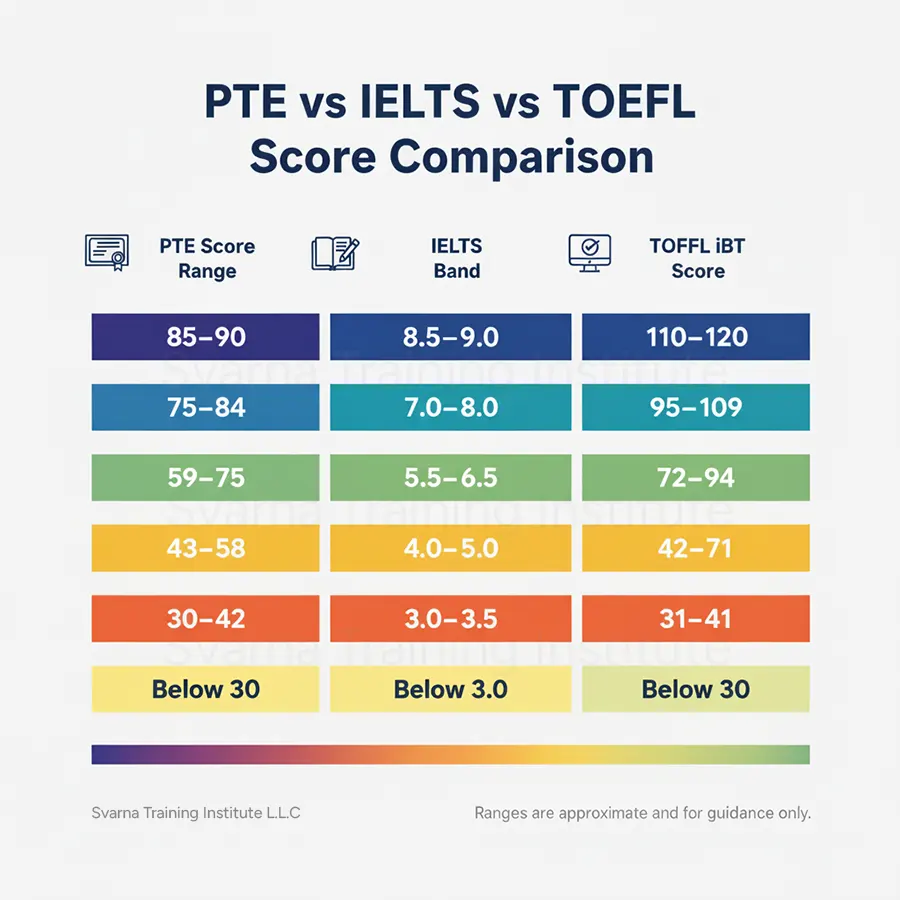
TOEFL vs PTE vs IELTS Score Comparison, How They Translate
PTE and IELTS use completely different scoring systems, but universities, employers, and immigration bodies often provide equivalency tables to help compare results. Here’s a general comparison between IELTS and PTE scores
What This Means for You
- If your university or visa application requires IELTS 6.5, you’ll need at least a PTE 58-59.
- If you’re aiming for IELTS 7.0, that’s roughly a PTE 65.
- For top tier universities asking for IELTS 7.5+, expect to target PTE 73+.
Which Test Should You Take?
- Prefer AI-based scoring and a fast, computer only test? PTE might suit you better.
- Comfortable with a face to face Speaking test and human scoring? Go for IELTS.
- Check with your university or immigration authority some institutions accept one test but not the other.
Results Timeline
Waiting for test results can feel like an eternity, especially if you’re applying for university deadlines or immigration. Here’s how long you’ll need to wait for each test,
- PTE – Super fast you’ll typically get results in 1-2 days. One of the quickest turnaround times for English proficiency tests.
- IELTS – Paper based IELTS takes 13 days. Computer delivered IELTS is much faster, with results in 3-5 days.
- TOEFL – Takes 4-8 days, with an average of 6 days for online results.
Key Takeaway
- Need results ASAP? PTE is by far the fastest, often delivering scores within 48 hours.
- Taking the IELTS? Go for the computer-based version if you want results within 3-5 days instead of waiting nearly two weeks.
- TOEFL is somewhere in between, but still slower than PTE.
Acceptance
Choosing between PTE, IELTS, and TOEFL also depends on where your test score will be accepted. Here’s how they compare:
- PTE – Recognized by 3,000-3,500 institutions worldwide. Approved for immigration to Australia, New Zealand, the UK, and Canada. Used in 70+ countries.
- IELTS – The most widely recognized test, accepted by 11,000+ institutions in 140 countries. Recognized for immigration to the UK, Canada, Australia, and more (especially IELTS General Training for immigration).
- TOEFL – Also accepted by 11,000+ institutions, especially dominant in North America. Recognized for Australia and New Zealand immigration, but NOT used for UK visas (UK prefers IELTS or PTE SELT).
Key Takeaway
- Studying in the US? TOEFL is widely accepted.
- Applying for Canada, UK, or Australia? IELTS has the broadest recognition.
- Need a test for Australian or New Zealand immigration? PTE and IELTS are both strong choices.
- Applying to multiple regions? IELTS is the safest bet since it’s recognized almost everywhere.
Unique Features
Each test has special features that can be a pro or con depending on your strengths:
- PTE
- Integrated tasks your Speaking responses can impact Reading scores.
- Fully AI-scored no human bias.
- Fastest results (1-2 days).
- Everything in one sitting (no separate Speaking test).
- Unlimited free score sends big bonus if applying to multiple institutions.
- IELTS
- Face to face Speaking test a plus if you prefer human interaction.
- Option for paper based test good for those uncomfortable with computers.
- Scores come with a Test Report Form (TRF), useful for certain applications.
- TOEFL
- Academic style listening and reading great for students heading to universities in the US or Canada.
- Allows note taking, which helps with long listening sections.
- MyBest scores lets you combine your best section scores from multiple test attempts (IELTS & PTE don’t allow this).
Key Takeaway
- Want the fastest test with AI scoring? Go for PTE.
- Prefer talking to a real examiner? Choose IELTS.
- Planning to study in a university setting? TOEFL’s academic focus might suit you.
Difficulty Perception
There’s no “easiest” test difficulty depends on your strengths. But here’s what test takers commonly say
- PTE
- Easier for those comfortable with computers.
- No human examiner speaking into a mic can feel less intimidating.
- Fast-paced you need to keep up with multi tasking in some sections.
- IELTS
- More traditional format one skill at a time, which some find easier to manage.
- Speaking with a human can be stressful for introverts.
- Writing Task 2 (essay) is known for tough scoring, requiring strong academic writing skills.
- TOEFL
- Longer listening and reading passages can be tiring.
- Speaking responses are timed you must think fast and deliver clear answers under pressure.
- Some non US accents struggle with TOEFL’s American English bias (though ETS has worked to reduce this).
Key Takeaway
- Comfortable with computers and AI grading? PTE might feel easier.
- Prefer a structured, traditional exam format? IELTS is a good fit.
- Good at listening and academic English? TOEFL could be your best bet.
Which Test is Easier or Better? The Verdict
There’s no one-size-fits-all answer what’s “easier” depends on your strengths. But here’s how the three tests stack up across different sections,
Speaking – Human Interaction vs. AI
- IELTS – You’ll have a real conversation with a human examiner. This feels more natural for many test takers, but some find it stressful due to human judgment.
- PTE & TOEFL – You’ll speak into a microphone, and your responses will be graded later (by AI for PTE, by humans for TOEFL). Some students prefer this because they can rehearse responses without social anxiety.
- PTE’s AI scoring won’t misunderstand accents as long as your speech is clear it’s trained on multiple English accents and grades objectively.
Best for
- If you’re confident in real life conversations → Go for IELTS.
- If you’d rather not deal with a human examiner → PTE or TOEFL.
Writing – Strict Grading vs. AI Evaluation
- PTE – One 200-300 word essay + one sentence summaries. AI grading means it values structure and vocabulary over creative expression.
- IELTS – Two tasks a 150 word graph analysis + 250-word essay. Examiners strictly assess coherence, grammar, and lexical resources, making IELTS Writing one of the hardest sections to score high on.
- TOEFL – Two writing tasks one integrated task (reading / listening + writing) and one independent essay. The integrated nature makes it unique.
Best for
- If you’re good at structuring essays but want AI grading to avoid human bias → PTE.
- If you have strong academic writing skills and can impress human examiners → IELTS.
- If you’re comfortable with combining reading/listening into writing → TOEFL.
Reading – Traditional vs. Interactive Format
- PTE – Shorter passages with interactive questions (fill-in-the-blanks, reorder paragraphs). Some prefer this to standard multiple choice.
- IELTS – 3 long passages (40 questions total), intense but straightforward. Time management is critical.
- TOEFL – 3-4 academic level passages with multiple choice questions. More time per question than IELTS and the ability to navigate within a section.
Best for
- If you prefer short, interactive questions rather than long passages → PTE.
- If you’re comfortable tackling long, structured reading tasks → IELTS.
- If you want more time per question and don’t mind academic-style texts → TOEFL.
Listening – Endurance vs. Fragmented Tasks
- PTE – Lots of smaller listening tasks (summaries, dictation, fill-in-the-blanks). Requires sharp multitasking skills.
- IELTS – 40 questions from 4 recordings, done in one sitting (30-40 minutes). It’s an endurance test of focus.
- TOEFL – Long lectures and conversations with note-taking allowed, followed by multiple questions per recording.
Best for
- If you like fast paced tasks with varied question formats → PTE.
- If you prefer a traditional listening test with straightforward question types → IELTS.
- If you’re comfortable with note taking and answering multiple questions per recording → TOEFL.
Which Test Works Best for Immigration & University Admissions?
- For UK or Canada Immigration – IELTS has historically been the most recognized, but PTE is now equally accepted in many categories.
- For US universities – TOEFL and IELTS have been the go-to tests, but PTE is gaining recognition fast.
- For Australia & New Zealand – IELTS and PTE are widely accepted for visas and universities.
Check your specific institution’s or immigration authority’s website acceptance policies change, and some universities have a clear preference.
Final Decision on Which Test is Right for You?
If you’re still unsure, here’s how to decide based on your skills
Take PTE if…
- You prefer fast results (1-2 days).
- You’re tech savvy and comfortable with AI scoring.
- You want less human bias no examiners evaluating your speaking / writing.
- You like interactive questions instead of just multiple choice.
Take IELTS if…
- You prefer a traditional test format (paper based or computer based).
- You’re strong in face to face conversations and want to speak to a real examiner.
- You need the most widely accepted test for immigration / university applications.
Take TOEFL if…
- You’re comfortable with American academic English.
- You don’t mind long lectures and reading passages.
- You like note taking during listening.
- You want the option of MyBest scores (combining your highest section scores from multiple attempts).
Final Thought
- PTE is often seen as more “accessible” because of faster results, AI scoring, and more flexible question types.
- IELTS remains the “gold standard” in global recognition, but its Writing and Speaking sections can be more challenging.
- TOEFL is ideal for students applying to US / Canadian universities and is great for those comfortable with note-taking and academic-style English.
Bottom Line? Pick the test that plays to your strengths and get the score you need to open doors to your dream university or visa!
Related Articles
- How I Found the Best IELTS Classes Near Me in Dubai (Student Guide)
- How Svarna Training Institute Became Dubai’s Leading IDP Education and IELTS Testing Center
- IELTS vs TOEFL Which Is Easier in 2026? A Complete Student Decision Guide
- PTE Exam Secrets, 10 Shocking Facts To Change Your Score Forever
- PTE vs IELTS vs TOEFL (2026 Comparison)